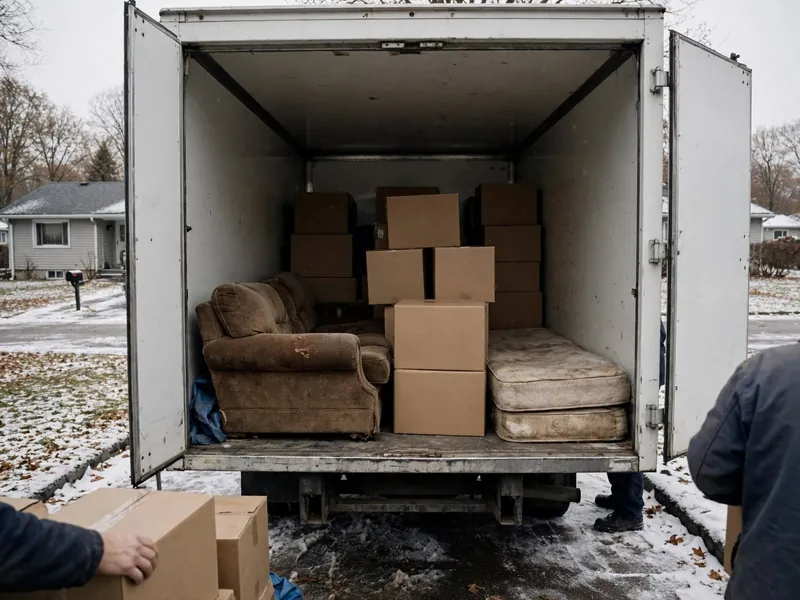
In short
- One request goes to one independent hauler, who calls with a price.
- City curbside collection takes 3 garbage items every two weeks; extra garbage goes in City yellow bags.
- Household hazardous waste events refuse containers over 20 litres and loads over 100 litres.
- Ontario HST is 13%, and Ottawa hauler lists differ on whether it is already in the price.
How a request moves
You send one request: what goes, where it sits, your postal code and when you can be home. It reaches Ottawa Junk Desk and we hand it to one independent hauler in your part of the City. The company calls, looks at your photos and names a price. The junk removal cost page sets published Ottawa figures side by side; price by truckload shows what each share holds.
What the City handles, and what it does not
The curb covers three garbage items per collection and unlimited recycling and green bins. Bulky pieces and furniture count as one item each. The rest of the list sits outside it: appliances, building waste, chemicals, batteries and electronics. The guides on bulky item rules, what haulers take and items haulers cannot take explain each group.
Choosing between a hauler and a bin
A crew carries the load out of the house. A bin sits in your driveway and you fill it. Bin rental or junk pickup compares the two, and bin rental prices gives the lists.
Jobs by room and item
Pick the closest job when you send the request: furniture, mattresses, appliances, renovation debris, a garage or a basement.
Questions to ask the company
- Is HST in the price you quote me?
- Which of my items need a separate fee or a separate stop?
- Can you tell from my photos which share of the truck this is?
- What do you do with items that cannot go to a landfill?
- Who comes on the day, and will you call before arriving?
Have this ready for the call
- Photos of the pile from two sides, with a door or a car for scale
- Your postal code and which floor or room the items sit in
- A short list of hard items: batteries, paint, propane, electronics, appliances
- Where a truck can stop and any stairs or narrow halls on the way
- The days and hours someone is home
Questions people ask
What happens after I send the form?
You describe what has to go, your postal code and when. We pass it to one independent Ottawa hauler that works in your area. That company calls you, prices the load and books the pickup.
Are you a junk removal company?
We own no truck. We run the form and the hand-off. The hauler that receives your request does the work, and the price, the date and the terms are between you and that company. Ask it on the call who will attend and to put the price in writing.
Which details make the first price accurate?
List the large pieces, add a count of anything with a fee or a rule, and give the postal code. Mention stairs. Two or three photos let the hauler estimate the share of the truck before the visit.
Does the quoted price include HST?
Ask. The Canada Revenue Agency puts Ontario at 13% HST. On the Ottawa lists we read, one firm states prices plus tax and another does not say. A written quote that shows the total with HST stops a surprise on the day.
How many things can I put out for the City?
Three garbage items every two weeks. A bag, a bin up to 140 litres and under 15 kg, or one bulky item each count as one. Anything above goes in a City yellow bag. Furniture cannot be bagged, so a fourth bulky piece stays behind.
When does the item go to the curb?
Any time from 6 pm on the eve of pickup up to 7 am on the day. It sits on the ground by the road, clear of the sidewalk, the roadway and any snowbank.
What happens if the City leaves my garbage?
Garbage above the three-item limit and outside a yellow bag stays. The crew leaves a courtesy tag explaining why. Bins with a fixed lid, bins over 15 kg and cardboard boxes also stay, apart from a taped box marked broken glass.
How do I set out an old carpet?
Rolled and tied in bundles of 4 ft by 2 ft at most, each under 15 kg. Every bundle uses one garbage slot. A whole room of carpet goes in a load; list the rooms and the hauler prices it.
Where do paint, cleaners and pesticides go?
To a City household hazardous waste event or back to a retailer. The events refuse containers over 20 litres and loads over 100 litres. The next event listed is 7 November 2026 at 200 Westbrook Road, 8 am to 4 pm, for Ottawa residents only.
Can I put an old battery in the garbage?
The City says never. Damaged batteries can overheat in garbage trucks. Tape the terminals and bag each battery separately, then take them to a drop-off location or a Call2Recycle box. Lithium-ion batteries from e-bikes and scooters need the same care.
Where do old TVs and computers go?
The Trail Waste Facility accepts electronic waste free, and many retailers take it back. Ask the hauler how it handles electronics before a TV joins a pile of furniture.
What about needles and old medication?
Sharps go in an approved sharps container, which pharmacies hand out free, and the full container goes back to a participating pharmacy. The City sends unused prescription drugs to pharmacies too. Keep both out of the junk pile.
What do I do with fireworks or ammunition?
Call Ottawa Police at 613-236-1222, and officers come to you for flares, bullets, explosives and firearms; the City asks residents to keep them away from police stations. Spent fireworks are different: the City says soak them in water for 24 hours, then place them in regular garbage.
Why is a dehumidifier handled like a fridge?
Fridges, freezers, air conditioners and dehumidifiers hold cooling chemicals. The City says a technician must remove them and tag the unit before a landfill site accepts it. An untagged unit is refused at the gate, so mention the appliance in your request.
Can my old stove, dryer or water heater go to the curb?
The City collects no stoves, dryers, dishwashers, hot water tanks, furnaces or oil tanks at the curb. Residents arrange their own removal. Pick Appliance pickup in the request, name each unit and say whether it sits in a basement or on the main floor.
Is pressure-treated lumber ordinary garbage?
The City lists wood, including pressure-treated lumber, plaster, drywall, concrete and asphalt as construction waste, kept out of regular garbage. It goes to a landfill site that accepts it. Choose Renovation debris in the request and estimate the amount.
Where does a smoke alarm or light bulb go?
A smoke alarm counts as non-hazardous and goes in regular garbage; the City lists it as non-recyclable. Energy-efficient and fluorescent bulbs go back to some local retailers or to a household hazardous waste event. Wrap glass in a box marked glass.
Does the City take scrap metal from an old bike or frame?
The Trail Waste Facility accepts metal frames as scrap metal at no charge when the load is sorted and separate. Remove an e-bike battery first. Scrap mixed in with other garbage is charged as garbage, so ask the hauler to keep metal apart.